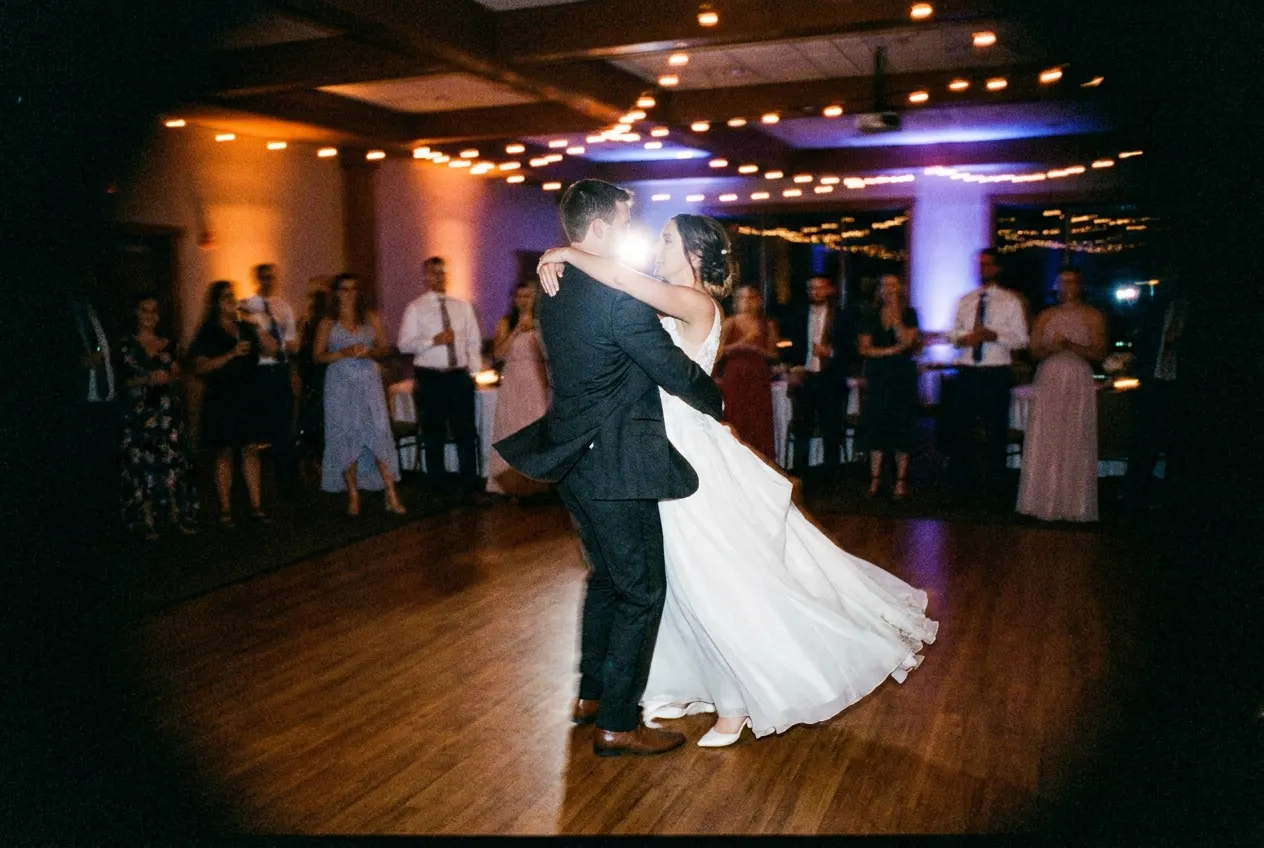
Cocktail Hour or Last Call? Placing the 360 Booth in Your Wedding Reception Timeline
“Should we book the 360 booth or the portrait station” is the wrong question. Both formats can run at the same wedding without competing for the same guests. The real question is when. They’re built for opposite moments in the night, and running either one at the wrong hour wastes what it’s actually good at.
This is the hour-by-hour case for placement: why the portrait station earns cocktail hour, why the 360 booth earns last call, and the honest cost of running both instead of picking one.
TL;DR
- A portrait station is built for stillness. A photographer directs each guest, which works best with cocktail-hour guests who are dressed, sober-ish, and willing to hold a pose.
- A 360 Video Booth is built for motion. A camera on a rotating arm shoots a slow-motion clip of guests moving, which needs the noise and energy of a dance floor already open.
- Portrait station setup runs about an hour, with 20–30 minutes to tear down (kimcarpenterportraits.com).
- A 360 booth needs roughly a 10x10 ft clear footprint and typically runs with two operators (clearchoicephotobooth.com; peekaboothusa.com).
- Booking both formats costs more and needs more floor space. The 360 Video Booth starts at $1,500, and a smaller wedding may only have the budget or the square footage to justify one format.

Two Formats, Built for Opposite Moments
The difference between a portrait station and a 360 Video Booth isn’t branding. It’s mechanics.
A portrait station is directed. A photographer poses the guest, gives one or two cues, and fires the shot the instant the expression lands. That needs a subject who can stand still and hold a pose a beat longer than feels natural. Early-night guests can do exactly that. They’re freshly dressed, the makeup hasn’t run, and the second drink hasn’t hit yet.
A 360 booth is the opposite kind of machine. The camera rides a rotating arm around a raised platform, capturing a slow-motion clip of whatever the guest does on it, commonly 15 to 30 seconds, shot around 120 frames per second (Photo Booth TO, Stay Golden Photo Booth). Stillness produces a boring clip. Motion is the whole product: a spin, a jump, a group throwing confetti. That’s a late-night behavior. Nobody spins on a platform before they’ve had a drink and the dance floor has given them permission to move like that.
Match the format to the hour and both experiences do their best work. Reverse them and you get a portrait station full of guests who are too loose to hold a pose, or a 360 booth full of guests too stiff to give it motion.
The Reception, Hour by Hour
Every wedding reception runs on its own clock, but the sequence of energy is close to universal: ceremony ends, cocktail hour opens, dinner and speeches hold the room still, then the dance floor opens and stays open until last call. The portrait station and the 360 booth belong at opposite ends of that sequence.
| Reception phase | Portrait station | 360 Video Booth |
|---|---|---|
| Cocktail hour | Peak window: guests are mingling, dressed at their best, and still at their sharpest | Not running: guests aren’t loosened up enough to give it motion |
| Dinner & speeches | Wrapped or winding down: a directed photo line has no place competing with plated service | Not running: the noise and crowd have no place near a toast |
| Dance floor opens | Long since packed away | First real activation, once the room has permission to be loud and physical again |
| Last call | Not applicable | Peak window: the floor is fullest, inhibitions are lowest, guests want a fast send-off |
everything the 360 Video Booth experience includes
Why Cocktail Hour Belongs to the Portrait Station
A portrait station belongs at cocktail hour because that’s the one stretch of the night built around unstructured guest time. That’s exactly what a directed setup needs.
Setup for a portrait station takes roughly an hour, built while you’re still in photos. Guests never see it happen. Teardown moves faster, at 20 to 30 minutes, since there’s less to calibrate than to build (multiple vendor sites, e.g. Kim Carpenter Portraits). One Chicago-market vendor structures a standard four-hour rental around roughly three hours of guests actually in front of the camera, with the remaining hour absorbed by setup and breakdown (Pixel Pro Photo Booths, retrieved 2026). That’s a useful ratio for sizing how much of a booking is guests in frame versus crew building the set.
The guest behavior lines up with that math. Cocktail hour guests are dressed at their best, mingling instead of seated, and not yet pulled toward the dance floor. Those are the exact conditions a directed photographer needs to get a clean frame. See the full breakdown of the portrait station wedding timeline, minute by minute for exactly how that window unfolds, or start with what a portrait station actually is for the complete category breakdown.
Why Last Call Belongs to the 360 Booth
A 360 booth belongs at last call because by then the room wants something the portrait station was never built to give it: motion, noise, and a crowd.
That’s the 360 booth’s entire premise. Guests climb onto an elevated platform, the camera sweeps around them on its rotating arm, and the result is a slow-motion clip built for exactly the kind of movement a loosened-up, dancing crowd produces naturally (Photo Booth TO). Running the booth this late isn’t just a scheduling choice. It’s matching the format to the only part of the night where guests are actually willing to perform for a camera instead of pose for one.
Placing the Booth So the Line Doesn’t Wreck the Night
A 360 booth needs real space, and where you put it matters as much as when you run it.
Plan on roughly a 10x10 ft clear footprint at minimum: the platform, the arm’s full rotation radius, and room for a small crowd to gather and watch (Clear Choice Photo Booth). It typically runs with two operators, one managing the platform and guest flow, the other handling the tech and the line (Peekabooth USA). Position it close enough that guests notice it and wander over on their own, but far enough from dinner tables, the speech microphone, and the center of the dance floor that its line and its noise don’t interrupt anything happening near it (PicBooth). full 360 Video Booth space and floor-plan requirements
The Honest Tradeoff: One Format or Both
Booking both a portrait station and a 360 booth costs more than booking one, and it needs more floor space than most venues set aside without being asked in advance. That’s not a sales caveat. It’s the actual math of running two separate crews, two separate setups, and two separate footprints across one night. YWNFI’s own 360 Video Booth starts at $1,500, a floor that sits inside the $900–$2,500 range most wedding 360 rentals run (clearchoicephotobooth.com; selfieboothco.com). Stacking a portrait station on top of that — starting at $2,950 — is what turns a single-crew night into a two-crew, two-footprint one. What either total lands on from there depends on format, hours, guest count, and travel. what a 360 Video Booth costs in the Chicago market
For a larger wedding with room to spare, running both isn’t redundant. It’s coverage for two different guest moods at two different hours, and it fits the broader 2026 pattern of receptions layering two or three entertainment formats instead of leaning on one all night (The Wedding Edition, GigSalad). A smaller wedding or a leaner budget is a legitimate reason to pick one and place it where it earns the most: cocktail hour for formal, guest-forward portraits, last call for a high-energy send-off. Neither choice is wrong; it’s a tradeoff, not a compromise. For more ways to fill the cocktail-hour window, see the full list of 2026 Chicago cocktail hour entertainment ideas.
Building This Into Your Own Timeline
Walk your actual day against this shape: ceremony end time, cocktail hour length, when dinner opens, when the floor opens. Back out an hour before cocktail hour starts if you’re booking the portrait station, and confirm with your venue that there’s a clear 10x10 ft spot near — but not inside — the dance floor if the 360 booth is on the list. The full experiences lineup, including the Photo Booth, is at /experiences/, and full-day placement examples live at /weddings/.
Frequently Asked Questions
Can we book both a portrait station and a 360 booth for one wedding, and does the timing actually work?
Yes. The two formats run at different hours by nature, so they don’t compete for the same guests or the same moment. The portrait station’s window is cocktail hour; the 360 booth’s window opens once the dance floor does. The real constraints are budget and floor space, not scheduling conflict.
What time should the 360 booth start running?
Once the dance floor has real energy: after dinner and speeches wrap and guests are already moving. Running it earlier, while guests are still seated or just arriving, wastes the format on a crowd that isn’t ready to perform for it yet.
If we can only afford one format, which one should we pick?
It depends on what you value more from the night. Pick the portrait station if formal, directed portraits of your guests matter most. Pick the 360 booth if a high-energy, shareable send-off during the last stretch of the party matters more. Both are legitimate answers.
Do the portrait station and the 360 booth need separate space, or can they share a footprint?
Separate space. A portrait station needs a backdrop, light stands, and room for a photographer to move around each guest; a 360 booth needs its own roughly 10x10 ft clear footprint for the platform and the arm’s rotation (Clear Choice Photo Booth). Since the two formats run at different hours, most venues can host both without a real scheduling conflict. They just need two distinct spots, not one shared one.
What if our reception doesn’t have an obvious “last call” moment?
Not every wedding runs until the literal last song. The 360 booth’s real cue isn’t the clock. It’s a dance floor that’s already full and loose. Whenever that moment lands on your timeline, that’s the booth’s window. Watch the floor, not the schedule, when you’re deciding when to bring it out.
Ready to place either format — or both — on your actual timeline? Request a quote or call (224) 434-3461 with your venue’s schedule in hand, and see the current pricing overview before you decide.