360 Video Booth Rentals: The Complete Guide for Weddings and Events
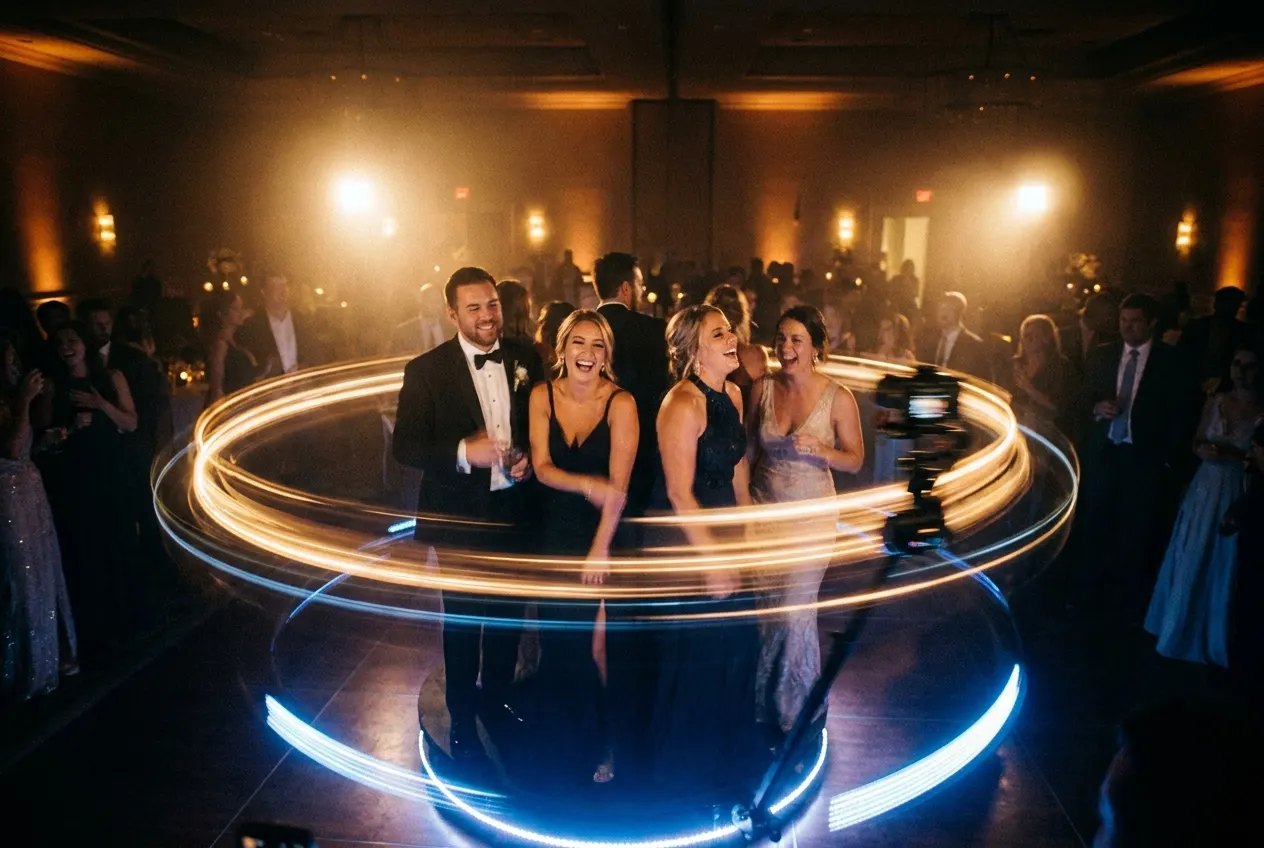
The dance floor is warm now, string lights catching sweat and sequins, and a small crowd has gathered around a raised platform in the corner. One guest steps up. A camera swings around them on a slim rotating arm, and for a few seconds the room narrows to just that one spinning figure. The clip plays back almost instantly — flying hair, a spinning skirt, a stranger’s laugh caught mid-turn — and the next guest is already climbing up before the last one steps down.
That’s a 360 video booth at work, built to do one thing well: turn a guest’s few seconds on a platform into a clip the room keeps replaying and sharing.
This guide covers what a 360 video booth actually is, how it works, what space and power it needs, what it costs across the market, where it fits inside a wedding or gala timeline, how it compares to other formats, and — honestly — when it’s the wrong call for your event. By the end, you’ll know exactly what you’re renting before you book it.
TL;DR
- A 360 video booth uses a camera on a rotating arm to circle a guest standing on an elevated platform, producing a short slow-motion clip, commonly shot at around 120 frames per second (photoboothto.ca, picbooth.ca, staygoldenphotobooth.com).
- A 360 video booth needs real floor space: a minimum of roughly 10x10 ft, with 12x12 ft or more for larger platforms, plus clearance around the spinning arm (clearchoicephotobooth.com, peekaboothusa.com).
- Market pricing for 360 booth rentals runs roughly $500–$3,000 per event, or about $199–$599 per hour, with most wedding bookings landing $900–$2,500 (selfieboothco.com, happyeventsus.com, clearchoicephotobooth.com).
- A 360 video booth favors mobile, high-energy guests and works best once the room has loosened up. It’s not the format for a formal, composed portrait.
- YWNFI’s 360 Video Booth starts from $1,500. Hours booked, guest count, and travel to your venue move the final number, so request a quote for your date.

What Is a 360 Video Booth?
A 360 video booth is an automated video rig: a guest (or a small group) stands on an elevated platform while a camera mounted on a rotating arm circles them, capturing the moment as a short slow-motion clip instead of a still photo.
The mechanics are consistent across the category. A motorized arm carries the camera in a full circle around the platform, and the footage is rendered in slow motion, typically a 15 to 30 second clip, shot at a frame rate commonly around 120 frames per second to smooth out the motion once it’s slowed down for playback (photoboothto.ca, picbooth.ca, staygoldenphotobooth.com). No one behind a lens is posing the guest shot by shot. The system runs the same circuit every time; what changes is what the guest brings to it: a jump, a twirl, a group throwing confetti at the exact right beat.
That’s the core distinction from a directed format. A 360 booth doesn’t direct. It captures motion, automatically, on a fixed mechanical path. The energy comes from the guest, not from a photographer’s eye.
Inside the Guest Experience
Stepping onto a 360 video booth platform feels less like a photo and more like a ten-second performance.
A guest (or two, or a small group) steps up onto the platform, the operator starts the sequence, and the arm begins its circle. There’s a beat to fill. Most guests jump, spin, throw their arms out, or pull a partner into a dip, because standing still on a spinning-camera rig looks and feels strange. The platform’s slight elevation matters here too: it separates the guest from the crowd just enough to turn the moment into something worth watching, the way a small stage does.
Then it’s over almost as fast as it started, and the room gets a slow-motion replay on a nearby screen before the file lands on a phone. That instant turnaround is the appeal. A 360 booth rewards guests immediately, in front of everyone, which is exactly why a line tends to form and stay formed once the first few clips start circulating.
Space, Power, and Staffing: What a 360 Video Booth Needs
A 360 video booth isn’t a plug-and-forget accessory. It has real physical requirements, and skipping this section is the most common way a booking goes sideways on event day.
Floor space. Plan on a minimum of about 10x10 ft of clear floor for the booth itself, with larger platforms requiring 12x12 ft or more once you account for the arm’s full rotation and a buffer zone between the spinning equipment and any nearby guests or furniture (clearchoicephotobooth.com, peekaboothusa.com). That buffer isn’t optional. The arm moves fast, and venues with tight corners or low ceilings need to be scouted before booking, not on the day of.
Power. The booth needs one standard outlet within about 5 metres of the setup location. It runs on carpet, wood, concrete, or smooth tile without much fuss, which makes most Chicagoland ballrooms, tents, and reception halls workable. The outlet distance still needs confirming with your venue ahead of time (picbooth.ca).
Staffing. A 360 booth typically runs with at least two operators on site: one managing the equipment and the automated sequence, one assisting guests on and off the platform, keeping the line moving and making sure no one steps up unsteady on their feet (peekaboothusa.com). That second person matters more than it sounds. An elevated platform with a moving arm overhead is not a self-serve station.
full 360 video booth space and power checklist for your venue
What Does a 360 Video Booth Cost?
360 video booth pricing spans a wide range across the market, and the honest driver is hours booked, add-ons, and how the package is structured.
Industry-wide, overall pricing for 360 booth rentals runs roughly $500 to $3,000 per event, with hourly rates commonly landing between $199 and $599 (selfieboothco.com, happyeventsus.com). Narrowed to weddings specifically, most 360 booth rentals fall in a tighter $900–$2,500 band (clearchoicephotobooth.com). A few published examples show how that range breaks down in practice.
| Vendor | Package length | Starting price |
|---|---|---|
| The PB Guy | 2 hours | $650 |
| The PB Guy | 3 hours (+$200/additional hour) | $850 |
| Austin Best DJs | 3 hours | $1,195 |
| Captured Celebrations (Los Angeles) | 3 hours | $1,400 |
Sources: thepbguy.com, austinbestdjs.com, capturedcelebrations.com. Captured Celebrations’ package bundles two attendants, digital delivery, and setup and breakdown into that base rate.
What moves the number inside that range:
- Hours booked, since setup and breakdown eat into a short rental more than a long one
- Number of attendants included
- Platform size and prop packages
- Digital delivery speed, branded overlays, and print or GIF add-ons
- Peak-season and Saturday-evening demand
YWNFI’s 360 Video Booth starts from $1,500, inside the $900–$2,500 wedding band above. That’s a starting floor, not a package total: what moves the final number is hours booked, guest count, and travel to your venue. Request a quote through our contact page with your date, or start with the full pricing page overview across all three experiences.
full Chicago 360 video booth cost breakdown
Where a 360 Video Booth Fits in Your Event Timeline
A 360 video booth fits best in the later stretch of a reception, once the dance floor has opened and guests are already moving. Placement matters here as much as booking length, and a 360 booth earns its spot at a different moment than a directed portrait station does.
Cocktail hour still belongs to composed, quieter formats. Guests are freshly arrived, dressed at their best, not yet loosened up. A 360 booth generally works better once the room has warmed up: after dinner, once the dance floor opens, or during the stretch of a reception when guests are already moving and looking for something to do between songs. The platform’s energy matches the room’s energy at that point instead of fighting it.
That doesn’t mean it’s locked to late-reception only. Some galas run a 360 booth near the entrance specifically to set an energetic tone from the first arrival. But for most weddings, the booth performs best once formality has relaxed and guests are already in motion.
how to place a 360 video booth in your reception timeline
360 Video Booth vs. Portrait Station vs. Photo Booth
A 360 video booth, a directed portrait station, and a photo booth all put a guest in front of a camera, but what each one asks of that guest — and what it hands back — is where they split apart.
| Format | Direction | Output | Best moment |
|---|---|---|---|
| Directed portrait station | Photographer poses and lights each guest | Composed still portrait | Cocktail hour, formal arrival |
| 360 video booth | Automated; the guest supplies the motion | Slow-motion video clip | After dinner, once the dance floor opens |
| Photo booth | Automated; minimal posing required | Still photo strip | Flexible, high-volume stretches |
A directed portrait station is the slowest and most composed of the three: a photographer poses each guest under real studio light, producing a still image built the way a studio portrait is built. It’s the format for a formalwear crowd at cocktail hour, when the room is still quiet and guests are still fresh.
A 360 video booth sits at the opposite end of the energy spectrum. Nobody directs the shot. The guest supplies the motion, the rig captures it automatically, and the output is a clip built for sharing, not a composed print. It’s built for a moving, loosened-up crowd, not a formal one.
A standard photo booth splits the difference on pace but not on output: fast, automated, and built for volume like the 360 booth, but producing a still strip rather than a slow-motion clip. Where the 360 booth demands motion and elevation, a photo booth asks almost nothing of the guest beyond stepping into frame.
None of the three replaces the others. Many high-end Chicagoland events book two, sometimes all three, because each one covers a different part of the night. A portrait station captures the room at its most composed; a 360 booth captures it at its most alive.
360 video booth vs. photo booth, compared feature by feature
When a 360 Video Booth Isn’t the Right Choice
A 360 booth is not the right call for every event, and the honest answer matters more here than the sales pitch.
It needs floor space you might not have. A venue with a tight footprint — a small private room, a packed tented reception, a historic space with awkward columns — may not have the clear 10x10 ft or larger footprint the rig requires, plus the buffer clearance around the spinning arm. Measure before you book, not after the crew arrives.
A line forms, and it can hold. Because the clip is the reward and the turnaround is fast, guests tend to queue and stay queued once word spreads. That’s a feature during an open dance-floor stretch and a problem if the booth is placed somewhere it blocks foot traffic or competes with a bar line.
It favors mobile guests. The platform is elevated, and the experience rewards jumping, spinning, and quick movement. Guests with mobility limitations, very young children, or anyone unsteady on a raised surface are better served by a ground-level format. If accessibility for your full guest list is a priority for a specific moment, a directed portrait station — no platform, no motion required — is the safer fit.
It’s the wrong tool for a formal portrait. If what you actually want is a composed, studio-quality image of every guest, a 360 booth won’t deliver that; it’s built for motion and energy, not stillness and direction. That’s what the portrait station is for.
360 video booth space requirements and venue red flags
YWNFI’s 360 Video Booth and the Full Lineup
YWNFI (You Will Never Forget It) runs exactly three experiences across Chicagoland: a directed portrait station, a 360 Video Booth, and a Photo Booth. The portrait station is the flagship, directed format; the 360 Video Booth is the automated, high-energy end of the lineup, built for the part of the night when the room is already moving.
Many events book both: a portrait station during cocktail hour for composed arrival images, a 360 Video Booth later once the dance floor is full and the crowd wants a fast, shareable moment. They’re not competing for the same job; they’re covering two different temperatures of the same night.
See the full portrait station page for the flagship service in detail, experiences page for how all three fit together, weddings page for how the lineup maps onto a Chicagoland wedding day, or browse past work in the gallery.
Frequently Asked Questions
What is a 360 video booth?
A 360 video booth is an automated video rig: a guest stands on an elevated platform while a camera mounted on a rotating arm circles them, capturing a short slow-motion clip instead of a still photo. No photographer directs the shot. The rig runs the same mechanical circuit every time, and clips are typically ready to view within seconds of the guest stepping off the platform.
How much space does a 360 photo booth need?
A 360 video booth needs a minimum of roughly 10x10 ft of clear floor, with larger platforms requiring 12x12 ft or more, plus a buffer zone around the spinning arm to keep guests and furniture clear of the equipment (clearchoicephotobooth.com, peekaboothusa.com). Venues with tight footprints or low ceilings should be scouted before booking.
How much does a 360 video booth rental cost?
360 video booth rental pricing runs roughly $500 to $3,000 per event overall, or about $199 to $599 per hour, with most wedding bookings landing in a $900–$2,500 range depending on hours and inclusions (selfieboothco.com, happyeventsus.com, clearchoicephotobooth.com). YWNFI’s 360 Video Booth starts from $1,500; hours booked, guest count, and travel to your venue are what move the final number, so request a quote for your date. full Chicago 360 video booth cost breakdown
Is a 360 video booth the same as a portrait station?
No. A portrait station is directed: a photographer poses and lights each guest for a composed still image. A 360 video booth is automated: a rotating camera captures the guest’s own motion as a slow-motion clip, with no one directing the shot. how a 360 video booth compares to a photo booth
Do I need a dedicated attendant for a 360 booth?
Yes. A 360 video booth typically runs with at least two operators on site: one managing the equipment and the automated sequence, one helping guests safely on and off the elevated platform. That second person matters because the booth isn’t a self-serve station. An elevated platform with a moving arm overhead needs someone watching the line (peekaboothusa.com).
When during the reception should we book the 360 video booth?
Most weddings place a 360 video booth after dinner or once the dance floor opens, when guests are already moving and the room’s energy matches the booth’s pace better than it does during a quieter cocktail hour. Some galas place it near the entrance instead, to set an energetic tone from the first arrival. how to place a 360 video booth in your reception timeline
The Takeaway
A 360 video booth trades direction for motion. No photographer posing the shot, just a guest, a spinning camera, and a slow-motion clip built to be shared before the song even ends. It needs real floor space, a power source nearby, and at least two people running it, and it earns its spot best once your room has already loosened up. It’s not a replacement for a directed portrait station; it’s the other end of the same lineup.
If a 360 Video Booth sounds right for your event, tell us your date, your venue, and your guest count, and we’ll build a quote around your night specifically. our contact page to start that conversation, or browse pricing page to see how the 360 Video Booth stacks up against the portrait station and Photo Booth.
You Will Never Forget It — Chicagoland event photography. (224) 434-3461.