← The Journal

360 Video Booth vs. Photo Booth vs. Portrait Station: Which Fits Your Reception?

Three formats, one reception, three different jobs. A 360 video booth spins. A photo booth prints. A portrait station poses and lights. Couples researching a 360 booth or photo booth for their wedding usually assume they’re choosing between two versions of the same thing. They’re not. Once you add the portrait station into the comparison, the real question stops being “which is better” and starts being “what do I want my guests to walk away holding.”

YWNFI runs all three as core experiences across Chicagoland weddings, engagement parties, and galas, so this comparison isn’t built to sell you toward one format. It’s built to show you, honestly, what each one asks of your room and gives back to your guests.

TL;DR

  • A 360 video booth produces motion. A slow-motion clip built for guests who want something shareable, fast.
  • A photo booth produces volume. A fast, printed strip that works for nearly every guest, every age, every mobility level.
  • A portrait station produces a composed portrait. Directed and lit, slower by design.
  • A 360 booth’s elevated platform favors mobile guests; a traditional photo booth is easier for older guests, young children, and guests with disabilities.
  • There’s no universal winner here. The right format depends on floor space, staffing, guest mix, and what moment in the night you’re covering.

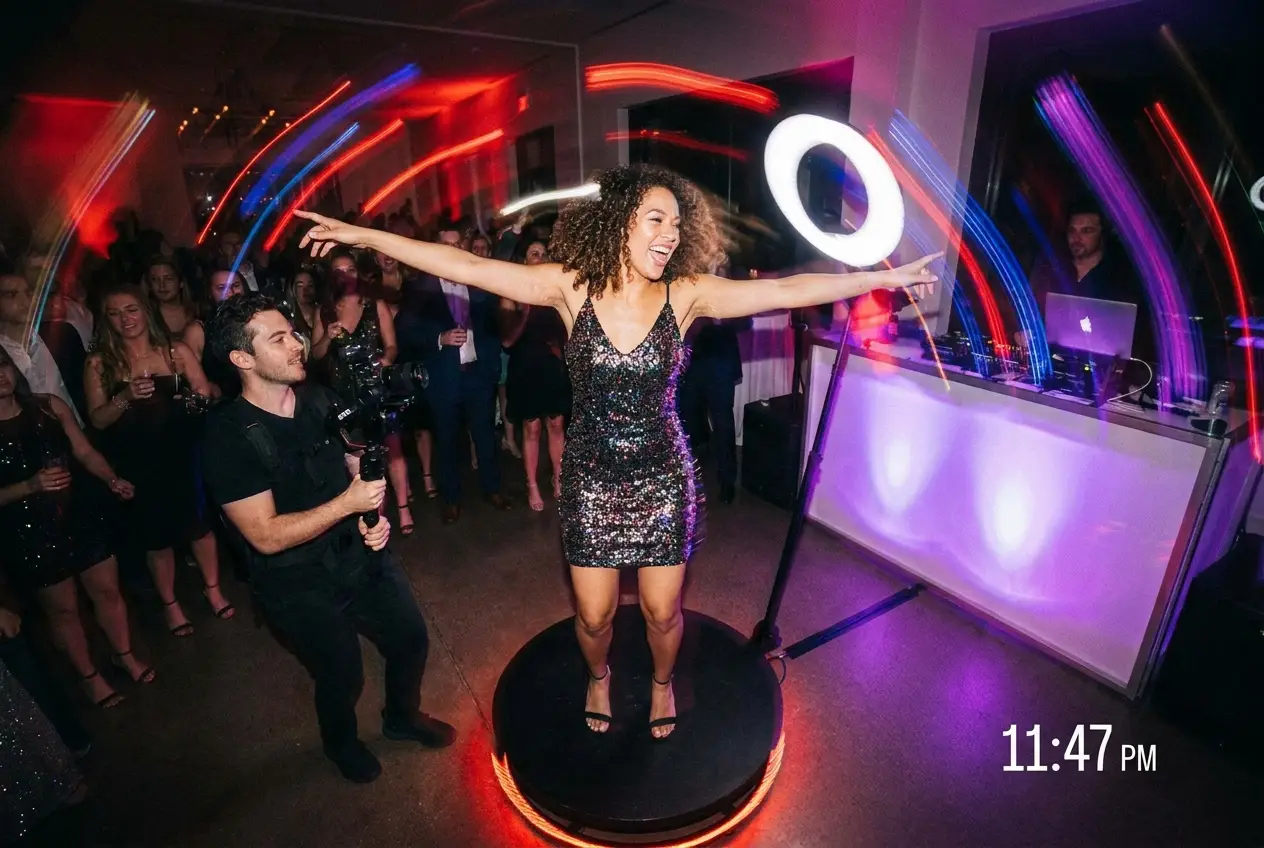
A 360 video booth platform with its rotating camera arm, set up in an event space

What Each Format Actually Gives the Guest

A 360 video booth, a photo booth, and a portrait station each send the guest home with a different kind of keepsake, and that output is what settles most of this decision before floor space or price ever enters the conversation.

A 360 video booth mounts a camera on a rotating arm that circles a guest standing on an elevated platform, capturing a slow-motion clip that typically runs about 15 to 30 seconds, often shot around 120 frames per second to get that smooth, cinematic slow-down (photoboothto.ca; staygoldenphotobooth.com). The guest doesn’t hold still for a portrait: they move, spin, throw confetti, pull a partner into frame. What they walk away with is motion. Video. Something built to post, not print.

A photo booth works the opposite way: a countdown, a flash, a printed strip in hand within seconds. No posing direction, no platform, no waiting for a render. The entire design is throughput: get the guest in, get the print out, keep the line moving. Portrait Station vs. Photo Booth: What’s Actually Different covers that comparison in full, feature by feature, if the photo booth side is your main question.

A portrait station sits apart from both. A photographer directs the shot, sets the light, and composes a single frame the way a studio sitting would. It’s the slowest of the three formats and the most deliberate. For the full category primer, see What Is a Portrait Station? The Complete Guide for Weddings, and for the mechanics of the 360 format specifically, see The Complete Guide to the 360 Video Booth.

The Comparison Table

This table compares the 360 video booth, photo booth, and portrait station side by side on format, output, floor space, staffing, best moment in the night, accessibility, and price band.

360 Video BoothPhoto BoothPortrait Station
FormatCamera on a rotating arm circles a guest on an elevated platformCountdown timer, flash, instant printPhotographer directs and lights each shot
What the guest walks away withA ~15–30 second slow-motion video clip, shareable digitallyA printed strip, fast and spontaneousA composed, studio-style portrait
Floor space neededMinimum ~10x10 ft clear, 12x12+ for larger platforms, plus buffer clearance (clearchoicephotobooth.com; peekaboothusa.com)Compact: a booth or open-air stand, minimal clearanceBackdrop plus room for a photographer to move around the guest
StaffingTypically at least two operators to manage the platform and line (peekaboothusa.com)Usually one attendantOne photographer directing, sometimes an assistant
Best moment in the nightHigh-energy stretch: later reception, after the dance floor opensAnytime the line needs to keep moving, especially late receptionCocktail hour, arrivals, formalwear crowd
AccessibilityFavors mobile guests: stepping onto a platform is part of the formatAccommodates all ages and mobility levels more comfortably, no platform to climb (tipbooth.com; clearchoicephotobooth.com)Ground-level, but a slower pace per guest
Price bandMost wedding rentals run $900–$2,500, with a broader market range of roughly $500–$3,000 and hourly rates around $199–$599 (clearchoicephotobooth.com; selfieboothco.com; happyeventsus.com); YWNFI’s 360 video booth starts from $1,500YWNFI’s photo booth starts from $1,100, final total set by hours and guest countYWNFI’s portrait station starts from $2,950, below Lumière Chicago’s $3,800-starting package (lumierechicago.com); other Chicago-market comparables include a $2,000+tax, 4-hour rental (Pixel Pro Photo Booths, pixelprobooths.com)

YWNFI publishes a starting price for each format: the portrait station from $2,950, the 360 video booth from $1,500, and the photo booth from $1,100. Every booking includes a 4x6 print handed to each guest on the night and the full edited gallery within two weeks. What moves the final total is format, hours, guest count, and travel. Request a custom quote at our contact page for a number built around your date.

Floor Space Is the First Real Constraint

Floor space is usually the first constraint that rules a format in or out, because a 360 video booth, photo booth, and portrait station each demand a different footprint from your venue.

A 360 video booth needs the most room of the three, and it’s not negotiable. Vendors set a minimum of roughly 10x10 feet of clear floor for a standard platform, with 12x12 feet or more recommended for larger setups, plus additional buffer space around the perimeter so the rotating arm has clearance and spinning guests don’t clip a wall or a passing server (clearchoicephotobooth.com; peekaboothusa.com). In a tented reception or a ballroom with a packed floor plan, that footprint competes directly with the dance floor, the bar, and guest seating.

A photo booth asks for almost nothing by comparison: a corner, an outlet, room for a short line. It can slide into a gap a 360 setup couldn’t fit into.

A portrait station lands in the middle: not as compact as a photo booth, but it doesn’t need the wide clearance a rotating arm demands. It needs a backdrop wall and enough room for a photographer to move and adjust light without bumping guests waiting their turn.

If your venue’s floor plan is tight, that alone may answer this question before accessibility or budget even come up. how much floor space does a 360 video booth actually need

Staffing Isn’t the Same Across Formats

A 360 booth typically runs with at least two operators: one managing the platform and guest flow, one running the capture and handling the render and playback (peekaboothusa.com). That’s a function of the format, not the vendor: someone has to keep the line organized while someone else manages the equipment mid-spin.

A photo booth usually runs fine with a single attendant, since the machine does the work once a guest steps in.

A portrait station is staffed by the photographer directly. There’s no separation between “the person running the equipment” and “the person creating the output,” because in a directed format, they’re the same job.

The Accessibility Question, Answered Honestly

Accessibility separates the 360 video booth from the photo booth and portrait station more sharply than any other factor, and it’s the part of the comparison most vendor sites skip.

A 360 video booth’s guest stands on an elevated platform for the shot. That’s simply how the format works. The rotating arm needs a raised, centered subject to circle cleanly. It’s a great fit for guests who move easily. It’s a harder ask for a grandparent in heels, a toddler who needs to be held, or a guest using a mobility aid.

A traditional photo booth, by contrast, accommodates a wider range of guests more comfortably: older guests, young children, and guests with disabilities generally have an easier time stepping into an open-air or enclosed booth than climbing onto a platform (tipbooth.com; clearchoicephotobooth.com). A portrait station is also ground-level and doesn’t require a platform, though its slower, directed pace means each guest spends more time in front of the camera than a quick booth pass.

If your guest list spans three generations, which most weddings do, this is worth weighing before floor space or aesthetics.

Where Each Format Wins the Night

The 360 video booth, photo booth, and portrait station each win a different part of the night rather than one format beating the other two outright. None of them is a universal winner, because each one is built for a different job:

The 360 video booth wins when the goal is energy and shareability: content built for a story, not a mantel. It earns its floor space best once the reception loosens up, when guests are already dancing and want to bring that motion into the format.

The photo booth wins on speed, volume, and inclusivity. If the priority is a line that never backs up and a format every guest can use without a second thought, this is the one.

The portrait station wins on composed, consistent output: a real portrait, not a snapshot, best suited to cocktail hour or arrivals when guests are still dressed at their sharpest and the room hasn’t picked up its later-night tempo. where a 360 video booth fits best in your reception timeline

Can You Book More Than One?

Yes — many Chicagoland couples book a portrait station, a 360 video booth, and a photo booth for the same event, pairing the portrait station for cocktail hour with a 360 booth or photo booth for the later, higher-energy stretch of the night. See the full experiences page lineup and weddings page for how the three pair together across a typical timeline.

Frequently Asked Questions

Is a 360 video booth worth it if you already have a photo booth?

A 360 video booth and a photo booth cover different moments, not the same one. A photo booth handles volume and speed throughout the night, moving a long line quickly with a printed strip. A 360 video booth adds a high-energy, shareable slow-motion clip once the room has warmed up. Many Chicagoland weddings book both formats rather than choosing just one.

Which format is easier for older guests or guests with disabilities, a 360 video booth or a photo booth?

A traditional photo booth is the more accessible option between the two automated formats. There’s no platform to climb, so older guests, young children, and guests using mobility aids generally have an easier time stepping into an open-air or enclosed booth (tipbooth.com; clearchoicephotobooth.com). A 360 video booth’s elevated platform favors guests who move easily, since the rotating arm needs a raised, centered subject to circle cleanly.

How much floor space does a 360 video booth need compared to a photo booth or portrait station?

A 360 video booth needs a minimum of about 10x10 feet of clear floor for a standard platform, with 12x12 feet or more recommended for larger setups, plus buffer space around the perimeter so the rotating arm has clearance (clearchoicephotobooth.com; peekaboothusa.com). A photo booth needs only a corner and an outlet by comparison, and a portrait station needs a backdrop wall plus room for a photographer to move.

How many staff does a 360 video booth need compared to a photo booth?

A 360 video booth typically runs with at least two operators: one managing the platform and guest flow, one handling the capture and render (peekaboothusa.com). A photo booth usually needs just one attendant, since the machine does the work once a guest steps in. A portrait station is staffed directly by the photographer, since directing the shot and creating the output are the same job.

How much does a 360 video booth cost compared to a photo booth?

Most 360 video booth wedding rentals fall between $900 and $2,500, with the broader market ranging roughly $500 to $3,000 and hourly rates around $199–$599 (clearchoicephotobooth.com; selfieboothco.com; happyeventsus.com). full 360 video booth cost breakdown for Chicago YWNFI publishes its own starting prices for both formats: the 360 video booth from $1,500, the photo booth from $1,100. Both floors move on hours, guest count, and travel. See the pricing page and our contact page for a number built around your date.

Can you book a portrait station, 360 video booth, and photo booth at the same wedding?

Yes, pairing formats for different parts of the night is common among Chicagoland couples. A portrait station typically covers cocktail hour or arrivals, while a 360 video booth or photo booth takes over once the reception’s energy picks up later in the evening, so each format covers the moment it actually suits.

The Takeaway

A 360 video booth, a photo booth, and a portrait station aren’t competing for the same job: they’re built for three different moments in the same night. Motion versus volume versus a composed portrait. Elevated platform versus ground-level access. Cocktail hour versus the dance floor.

Tell us your date, your venue, and your guest count, and we’ll help you match the right format, or combination of formats, to your reception. our contact page to start that conversation, or browse pricing page to see how all three experiences compare.

You Will Never Forget It — Chicagoland event photography. (224) 434-3461.

Your date only happens once.

We take a limited number of events per weekend so every room gets a full crew. If your date is set, find out now.