What Is a Portrait Station? The Complete Guide for Weddings
The room is loud. The photo booth line is longer than the bar line. Someone is holding a foam finger. Somewhere in that noise, a different kind of station is quietly doing something else entirely, placing a guest under real light, giving them one clear direction, and producing a portrait instead of a snapshot.
That is a portrait station. It’s one of the formats Chicagoland couples ask about most this year, precisely because it solves a problem the standard photo booth never could: guests want to look like themselves at their best, not like they’re mid-laugh at a costume party.
This guide covers what a portrait station actually is, how it differs from a photo booth, what it costs across the Chicago market, how the timeline works on event day, and how to evaluate a vendor before you book one. By the end, you’ll know exactly what you’re buying and what questions to ask before you sign. Browse the gallery to see the look this format produces.
TL;DR
- A portrait station is a directed, photographer-guided setup with studio lighting, not a self-serve booth with a timer.
- Chicago-market portrait station packages start around $3,800 and climb toward $6,500 or more depending on hours and add-ons (Lumière Chicago, retrieved 2026).
- Setup takes about an hour before shooting begins, with teardown running 20-30 minutes afterward (Kim Carpenter Portraits).
- A portrait station fits weddings, engagement parties, and galas equally well; the difference is framing, not format.
- YWNFI’s portrait station starts from $2,950, below Lumière Chicago’s published $3,800 floor; request a custom quote for your exact number.

What Is a Portrait Station?
A portrait station is a directed, studio-lit setup where a photographer guides each guest or group through a real portrait (posing, expression, framing) instead of leaving them to a timer and a filter.
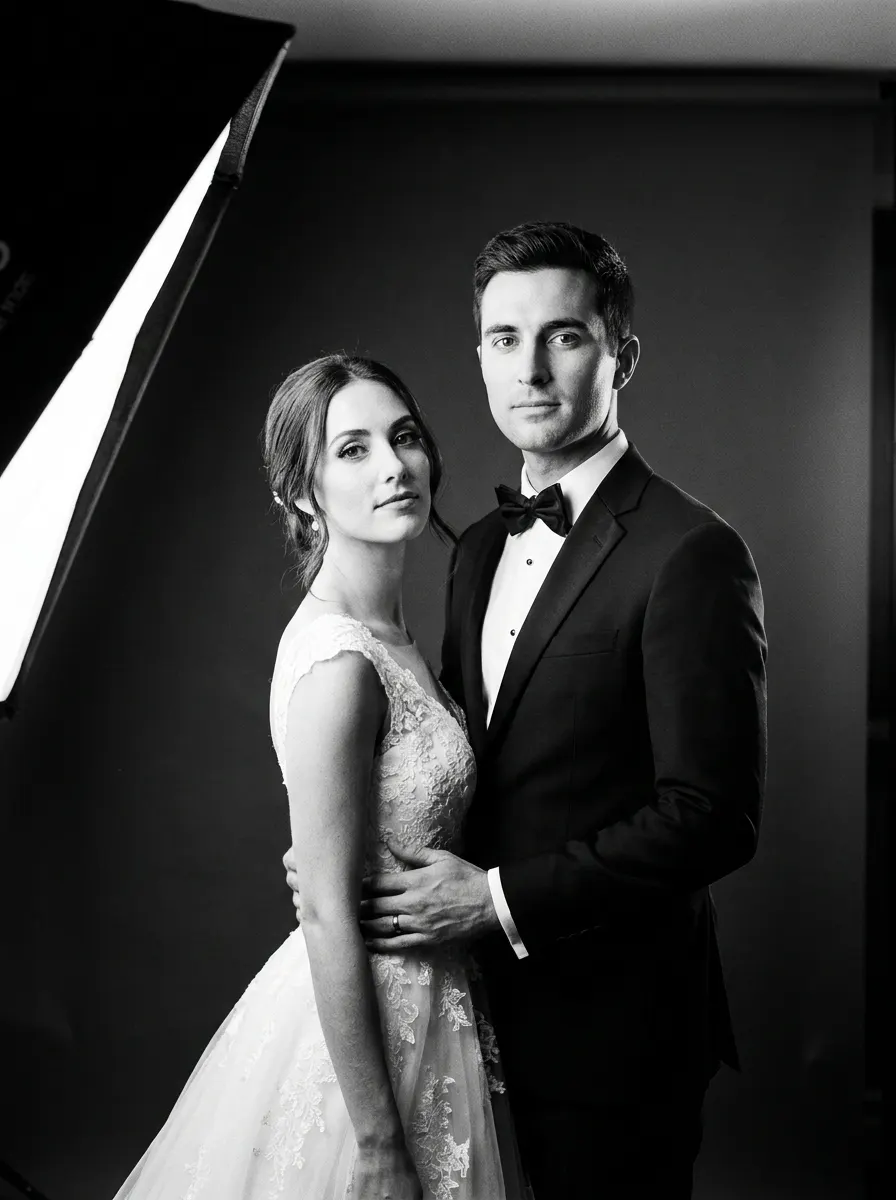
That single word, directed, is the whole category. A portrait station borrows its posture from an editorial photo shoot and drops it into the middle of a wedding reception. There’s a backdrop, real studio strobes or continuous light, and a photographer who tells you where to stand, where to look, and when to hold still. The guest doesn’t press a button. The guest is photographed.
The category sits between two older ideas that people already understand: a formal photographer session and a photo booth. A portrait station takes the intentionality of the first and the accessibility of the second, then sheds the weaknesses of both: no appointment required like the formal session, no unpredictable results like the booth.
Key components of a real portrait station:
- A photographer or director actively posing and cueing each subject
- Professional studio lighting, not ambient room light or a ring light
- A styled backdrop matched to the couple’s palette or the event’s design
- Same-day or next-day digital delivery, sometimes with a printed take-home
- A stage, not a curtain. The setup reads as a moment worth stopping for, not a booth you duck into
What a portrait station is not: it is not automated, it is not a self-timer setup, and it is not a novelty prop wall. If a station has a countdown timer and no one directing the shot, it’s a photo booth wearing a portrait station’s name.
how a portrait station differs from a photo booth
Portrait Station vs. Photo Booth: The Real Difference
The core difference between a portrait station and a photo booth is directed versus automated. Everything else follows from that one distinction.
A photo booth is a machine. You step in, a timer counts down, a flash fires, and the machine hands you a strip. The photo booth’s job is speed and volume: get as many guests through as possible, keep the line moving, keep the mood light. That’s a legitimate job, and it’s why YWNFI still offers a Photo Booth as one of its three core experiences: some moments call for fast and fun, not directed and composed.
A portrait station has a human in the loop at every shot. The photographer reads the guest, adjusts the pose, checks the light, and often takes two or three frames before landing on the one that works. The pace is slower. The output is different in kind, not just in quality. A photo booth produces a strip of a moment; a portrait station produces an image built the way a studio portrait is built.
The atmosphere differs too. A photo booth invites props, faces, and chaos. That’s the appeal. A portrait station invites stillness. The guest steps into real light, hears a direction, and holds a pose for a second longer than feels natural. That second is where the portrait happens.
Neither format is “better” in the abstract. A gala might want both: a portrait station near the entrance for arrival photos, a photo booth near the bar for the after-ten-o’clock crowd. see the full experiences lineup.
| Aspect | Portrait Station | Photo Booth |
|---|---|---|
| Format | Directed, photographer-guided | Automated, self-serve |
| Lighting | Real studio strobes or continuous light | Built-in flash or ring light |
| Pace | Slower, one guest or group at a time | Fast, high-volume |
| Output | Constructed studio-quality portrait | Snapshot strip |
| Mood | Composed stillness | Props, energy, chaos |
| Best fit | Cocktail hour, galas, editorial-style coverage | High-energy stretches, late-night crowd |
For a side-by-side breakdown of format, output, footprint, and best-fit event size, see the dedicated comparison. portrait station vs. photo booth, feature by feature
How a Portrait Station Works: The Event-Day Timeline
A portrait station runs on a simple rhythm: build the set, shoot for the bulk of the event window, strike the set, with roughly an hour on either end for setup and teardown combined.
Setup (about 60 minutes). The crew arrives ahead of guest time and builds the physical station: backdrop, lighting stands, modifiers, a shooting position with enough clearance for the photographer to move. This window matches typical industry practice. Vendors across the category budget close to an hour to get a station shoot-ready before the first guest steps in front of the light (multiple vendor sites, e.g. Kim Carpenter Portraits).
Active shooting. This is the bulk of the booking: the hours guests actually flow through the station. Pixel Pro Photo Booths, a Chicago-market vendor, structures a standard rental around roughly three hours of active shooting inside a four-hour booking, with the remaining time absorbed by setup and breakdown (Pixel Pro Photo Booths, retrieved 2026). That ratio is a useful planning baseline for any couple mapping a portrait station against their own reception length.
Teardown (20–30 minutes). Faster than setup, since there’s less to calibrate: mostly breaking the stands, packing the light, and clearing the space (multiple vendor sites, e.g. Kim Carpenter Portraits).
For a wedding specifically, placement in the day matters more than raw duration. Cocktail hour is the most common slot. Guests are mingling, dressed at their best, and not yet pulled onto the dance floor. Some couples run the station through part of the reception instead, especially if cocktail hour is short. how to place a portrait station in your wedding-day schedule
The room changes shape around the station without anyone announcing it. Guests notice the light before they notice the camera.
What Does a Portrait Station Cost?
Portrait station pricing in the Chicago market spans a wide range, and the honest answer is: it depends on hours, crew size, and what’s bundled in.
Two Chicago-area data points frame the range. Lumière Chicago publishes a “Portrait Station” package starting at $3,800, with most couples landing between $4,800 and $6,500 depending on add-ons (Lumière Chicago, retrieved 2026). That’s a premium-tier reference point, useful for understanding where the top of the market sits, not a number every vendor matches. On the lower end, Pixel Pro Photo Booths prices a 4-hour portrait-station rental starting at $2,000 plus tax, with about three of those hours as active shooting time (Pixel Pro Photo Booths, retrieved 2026).
For context, not substitution: The Knot’s Real Weddings Study puts average wedding photographer cost in the $2,000–$3,000 range (The Knot). A portrait station is not a replacement for a wedding photographer. It’s an addition that captures guests, not just the couple, in a directed format the primary photographer often doesn’t have bandwidth to deliver during a busy reception.
What moves the price inside that range:
- Number of hours booked (setup and teardown eat into a short booking more than a long one)
- Whether a second shooter or assistant is included
- Backdrop customization and props
- Print delivery versus digital-only
- Peak-season and Saturday-evening demand in the Chicago market
YWNFI publishes a real starting price instead of asking you to guess: the portrait station starts from $2,950, sitting below Lumière Chicago’s published $3,800 floor for the same category (Lumière Chicago, retrieved 2026). That number is a floor, not a package total. What moves it from there is the same list above: hours booked, a second shooter, backdrop customization, and print delivery. Request a custom quote through our contact page for the exact number once your date, hours, and venue are set, or start with the full pricing page overview across all three experiences.
For a deeper breakdown of what drives Chicago-specific pricing line by line, see the dedicated cost guide. full Chicago portrait station cost breakdown
Black-and-White or Color: The Directed Look
The look of a portrait station is a design decision, not an accident, and black-and-white is one of the category’s signature choices.
Black-and-white strips a portrait down to expression, light, and shape. It reads as timeless in a way color sometimes doesn’t, and it forgives a mismatched cocktail-hour dress code better than color does. A directed black-and-white portrait, shot under real studio light with a photographer controlling contrast and shadow, produces something closer to an editorial print than a party photo.
Color, meanwhile, keeps the room’s palette alive in the image: the couple’s florals, the venue’s uplighting, the specific gold of a Chicago ballroom at eight in the evening. Some couples run both, letting the photographer choose per shot or splitting the station’s output across the event.
Neither choice changes the mechanics of directed shooting. The photographer still poses, still cues, still controls the light either way. It’s a styling decision layered on top of the same core experience.
how to choose between black-and-white and color for your portrait station
Portrait Station vs. Hiring a Second Photographer
A portrait station and a second photographer solve overlapping but distinct problems, and understanding the difference helps you decide whether you need one, the other, or both.
A second photographer follows the day (candids, family formals, reception coverage), moving with the event rather than anchored to one spot. A portrait station stays put. It’s a fixed location guests come to, which means it captures people a roaming photographer might miss entirely: the second cousin who left before the toasts, the coworker table that never made it onto the dance floor.
The output differs too. A second photographer’s images are documentary; they show what happened. A portrait station’s images are constructed; they show how someone looked when given one clear direction and real light. Both have value. Many high-end Chicago weddings now book both roles separately rather than asking one photographer to do the work of two.
| Aspect | Portrait Station | Second Photographer |
|---|---|---|
| What it covers | A fixed setup guests step into for a directed, studio-lit portrait | Roaming coverage that follows the day: candids, family formals, reception moments |
| Output | Constructed studio portrait, posed and lit | Documentary images of the day as it unfolds |
| Typical relationship to your photography budget | Shorter, contained add-on; Chicago packages from $3,800, most couples $4,800-$6,500 (Lumière Chicago) | Primary coverage; average wedding photographer cost runs $2,000-$3,000 (The Knot) |
Budget-wise, a portrait station is typically a shorter, more contained booking than a full second-photographer package, which makes it easier to add on top of an existing photography contract rather than replace it.
portrait station vs. a second wedding photographer, cost and coverage compared
Where a Portrait Station Fits: Event Types
A portrait station scales cleanly across three event categories that share one trait: a guest list dressed up and worth photographing.
Weddings
This is the category’s home base. Cocktail hour is the natural slot, though some couples run the station into the reception. The directed format matches the formality of a wedding better than a self-serve booth does. It feels like part of the day’s design, not an add-on activity. See the full weddings page for how YWNFI’s flagship experience fits into a Chicagoland wedding day specifically.
Engagement Parties
Smaller guest count, shorter window, but the same directed format works, often at a lower hour count than a full wedding booking. An engagement party portrait station also doubles as a content source for save-the-dates and wedding-website galleries, since the images already carry a studio-portrait quality.
running a portrait station at an engagement party
Galas and Corporate Events
Corporate and gala settings shift the framing but not the mechanics. A portrait station at a gala still directs, still lights, still composes. What changes is the branding layer: a step-and-repeat backdrop, a logo, an executive headshot pass at the top of the evening before the room fills. For organizations that need polished attendee photos without hiring a full studio crew, a portrait station delivers that in a single booking.
portrait stations for galas and corporate events
How This Fits the Bigger Reception Picture
A portrait station rarely stands alone anymore. It’s increasingly one layer in a reception that stacks two or three entertainment categories instead of leaning on a single DJ playlist.
2026 wedding-entertainment signals point toward exactly that kind of layering: live vinyl DJ sets, silent discos, live illustration or watercolor artists working the room in real time, and roaming acoustic performers moving between tables (industry trend coverage via The Wedding Edition, GigSalad, Inside Weddings, and The Fillmore KC). A directed portrait station slots naturally into that mix. It’s active during cocktail hour, quiets down once dinner starts, and hands the room off to whatever comes next.
The atmospheric shift is real: a room with only a DJ and a bar feels like one note held too long. A room with a portrait station, a roaming performer, and a DJ set feels like it’s breathing.
2026 Chicago wedding cocktail hour ideas beyond the bar
How to Evaluate a Portrait Station Vendor
Evaluating a portrait station vendor means asking about the parts they can’t fake on a sales call, not just admiring the highlight reel every vendor will show you.
Ask to see raw, unedited frames, not just the highlight reel. Anyone can curate ten perfect images from a busy night. Unedited samples show you the miss rate and the actual lighting consistency.
Ask who is behind the camera. A directed portrait station lives or dies on the photographer’s ability to pose strangers quickly and put them at ease. A vendor who can’t answer “who will be shooting at my event” specifically is a red flag.
Ask about the light, not just the backdrop. Backdrops are the easy, visible part. Studio lighting (modifiers, positioning, consistency across dozens of guests in a row) is the harder, less visible part that actually determines image quality.
Ask about delivery timeline and format. Same-day previews, next-day full galleries, print options: get this in writing before you book.
Ask what happens if a guest doesn’t want to be photographed. A good directed setup has an easy, low-friction way to opt out without disrupting the flow.
the full portrait station vendor checklist
YWNFI’s Portrait Station and Where It Fits
YWNFI (You Will Never Forget It) runs exactly three experiences across Chicagoland: a directed portrait station, a 360 Video Booth, and a Photo Booth. The portrait station is the flagship: the directed, studio-lit format described throughout this guide, built for weddings, engagement parties, and galas that want a stage, not a curtain.
The 360 Video Booth and Photo Booth cover the automated end of the spectrum: faster, higher-volume, built for guests who want quick, fun content rather than a directed portrait. Many events book more than one experience from the lineup, pairing the portrait station’s controlled output with the energy of a video booth later in the night.
See the full portrait station page for the flagship service in detail, or experiences page for how all three fit together. Browse past work in the gallery.
Frequently Asked Questions
What is a portrait station at a wedding?
A portrait station is a directed, photographer-guided setup with studio lighting where guests are posed and shot individually or in groups, producing portrait-quality images rather than automated booth snapshots. It’s typically staffed by a photographer who actively cues each guest, uses real studio strobes or continuous lighting, and delivers images digitally, often with a print option.
How is a portrait station different from a photo booth?
The core difference is directed versus automated: a portrait station has a photographer actively posing and lighting each shot, while a photo booth runs on a timer with no one directing the frame. Both have a place at an event. A photo booth favors speed and volume, while a portrait station favors composed, studio-quality output.
How much does a portrait station cost in Chicago?
Chicago-market portrait station pricing ranges from roughly $2,000 for a shorter rental up to $6,500 or more for a full-service package, depending on hours, crew, and add-ons (Pixel Pro Photo Booths; Lumière Chicago, retrieved 2026). YWNFI’s own portrait station starts from $2,950, below Lumière Chicago’s published $3,800 floor for the same category. That’s a starting price, not a package total: request a custom quote for the exact number once hours, crew, and add-ons are set. full Chicago cost breakdown
How long does it take to set up a portrait station?
Setup typically takes about an hour before shooting begins, with teardown running 20 to 30 minutes afterward, based on common industry practice across multiple vendors (e.g. Kim Carpenter Portraits). Booking length should account for this window on both ends, not just the active shooting time.
Do I need a portrait station if I already have a wedding photographer?
A portrait station complements a wedding photographer rather than replacing one. The photographer documents your day as it unfolds, while the station captures a directed portrait of every guest who steps in front of it, including people your main photographer may never reach during a busy reception. portrait station vs. a second photographer, compared in detail
What event types work best with a portrait station?
Weddings, engagement parties, and galas all work well, since the common requirement is simply a dressed-up guest list worth photographing. Weddings typically place the station at cocktail hour, engagement parties run it at a smaller scale, and galas often add branded backdrops for a corporate or fundraising context.
The Takeaway
A portrait station is the directed alternative to the automated photo booth: real light, a photographer’s eye, and a guest who looks like their best self instead of a blurred snapshot. It fits weddings, engagement parties, and galas equally well, with pricing across the Chicago market driven mostly by hours booked and what’s bundled in.
If a portrait station sounds right for your event, the next step is simple: tell us your date, your venue, and your guest count, and we’ll build a quote around your night specifically, not a generic package. our contact page to start that conversation, or browse pricing page first to see how the portrait station stacks up against the 360 Video Booth and Photo Booth.
You Will Never Forget It: Chicagoland event photography. (224) 434-3461.